Sunday, October 27, 2013

Is hacking Ethical?

This week I'm going to talk about hackers. Not to be confused with when you leave your Facebook logged in and your friend comes and makes an embarrassing post. That's not hacking. Hacking has to do with different inputs to crack a password and access an account, not an account you happened to leave logged in. With the air cleared on that there are different types of hackers. White hat hackers hack for a corporation to make that corporations product is secure. They do penetration testing to make sure other color hats don't break into their system or program. The next color of hat is black hat hackers. Black hat hackers break into systems typically for personal gain. They steal identities, credit cards, etc. to either sell or to create chaos for a company or person. Gray hat hackers are the gray area of hacking. Gray hat hackers will try to compromise a system just to well... test it. They will alert the company of the security programs if they find them usually. However there have been a lot of anger towards gray hat hackers. Companies have started suing them for exposing the security problems instead of thanking them or fixing the breaches. These people are who hack for fun, not for profit by like a white or black hat hacker.

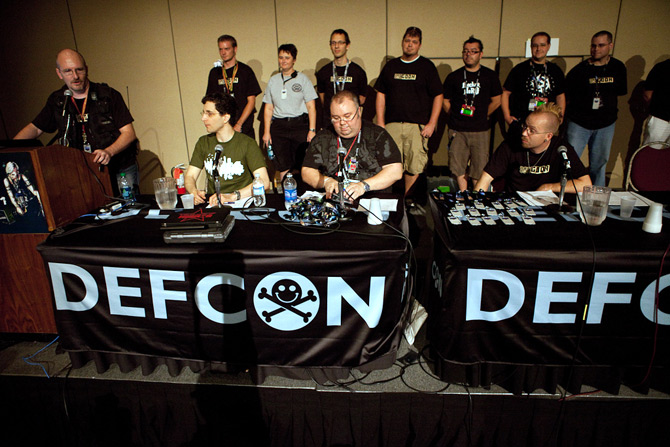
With all of that laid out. There is a convention for hackers called Def-con. Def-con is a hacking convention where companies and hackers and until most recently NSA would attend to show off their latest tools they've developed. One particular tool that was incredibly interesting is a program that listens to wireless traffic. Dependent on the port that information was sent by, the program could determine what each device was on the network. The best part of this program was, no one would know if you were listening. as in your device wouldn't intercept and repeat the signal, it would receive the broadcasted and message without anyone knowing the wiser that it was listening. There has been a worldwide outcry over our government hacking other governments information along with its own citizens information. People cry foul as this would be consider black hat hacking. The government refuses to tell us what they're using the information or gathering it in the first place. It also hurt a lot of big Tech businesses here in America. as mentioned in an aritcile by Cecilia Kang and Ellen Nakashima, "Cisco has said it is already seeing customers, especially those overseas, back away from U.S.-branded technology after documents revealed that the NSA enlisted tech firms and also secretly tapped into their data hubs around the world as the agency pursued terrorism suspects." After these revelation they were barred from attending Def-con this last year.

There are so many different types of hacking that it may be construed to people only thinking its bad. Hackers Anonymous are always pegged as the bad guys even when they expose corruption in our government. Sometimes hackers are bad, sometimes they're good, sometimes they're the unsung heroes that we need to expose the truth. hacking gives us knowledge and security, if used for the right reasons.


 Cecilia Kang and Ellen Nakashima Article:
http://www.post-gazette.com/news/nation/2013/12/18/Tech-CEOs-to-Obama-NSA-s-hacking-hurt-our-business/stories/201312180059

Tuesday, September 24, 2013

How to Promote Yourself Online

its a logo man! linked in
Today's world revolves around technology and information online. One major shift we have seen in recent years is more and more companies are reviewing applicants online. There's no longer a job application you get from going to the business and filling out, it's all online. Not only is it all online resumes but also other forms of communication that show who you are. One particular social networking site is just for jobs and jobs alone. Linked in is a professional networking site that allows people to connect for business purposes. However, just like MySpace and Facebook, you create a linked in profile that shows your professional behavior, in other words, its your online resume.

How to sell it:
Look at other peoples profiles, it will give you a general sense of what you should be putting up on your profile and what you should not be. One thing to consider is these people are your competition, you want to have what they have on their profile and more. Take their information and see if it can be represented better or in a different way.

It is your online Resume:
Remember that your LinkedIn profile is your online profile for all employers to look at. This means have a professional picture to use for your profile. As Michael Poh mentions in his blog "For LinkedIn, it is expected for your bio to reveal your experience and expertise, your educational background along with various accomplishments in your career." As in you should optimize each social network site for what that site is used for. No employer wants to look at your profile and you have a picture of you doing a keg-stand at a party you're way too old to be at. Keep it professional. List your skills and attributes and how they relate to your line of work. If you're a programmer applying for a job at programming for a car company, put cars as one of your interests. Be sure to write about yourself in your LinkedIn profile. Triple check for grammar and spelling mistakes, as it could be your undoing for a potential employer.

When you create this profile remember it represents you, but only the professional you. keep all the other information for Facebook and MySpace for expressing yourself.

Michael Poh's Bog:
http://www.hongkiat.com/blog/optimizing-online-presence-for-jobs/

Wednesday, September 11, 2013

QR codes: why?

It's a QRcode jesus QR codes are a relatively new form of advertising. They are these little "two-dimensional (2-D) matrix code that belongs to a larger set of machine-readable codes" - DENSO that companies use to promote whatever they like really. They show up in magazines, posters, cereal boxes etc. that you can scan with your smart phone or tablet. What they bring up is a mystery until you scan it. They typically have phone numbers, a Facebook, a website, or even a
blog that belongs to a user. The one I have included in this blog links to well... my blog. Professionals may use them on business cards to link to their website which has their resume posted.


Why Would I personally use it?
You can use it for whatever you like! There are a million different uses that are only limited by your imagination. I just used one for my blog, partially because hey I'm required to, but also because it’s interesting. You can prank your friends, mess with your coworkers, and advertise yourself! As I mentioned it’s a way that you can advertise yourself to people and this is a great way if you are advertising major. However, be careful with how much you rely on them, sometimes its too much of a hassle, as Graham Charlton says in his blog, "Make sure the QR code serves a purpose and adds to the user experience." What he means is don't post QR codes for every little thing! make their use efficient not bothersome. It shows that even the even though it’s barely 50% of people that scan QR codes, you still understand and can reach that group of people.


Cons of QR codes:
The main problem with QR codes is something I mentioned before: it’s a mystery to what they link to. QR codes can go to websites that contain malicious code for your device or to some obscure inappropriate website. With that said, that’s why there are only about 50% of people who scan them in public. The ones posted in magazines and newspapers are more trusted but it still comes down to the possibility of the QR code being unsafe. It's like taking a trust fall with people you've never met and can only trust their reputation.


Overall....
Like I said though it’s a great way to advertise and take polls and gives you an easy way to link something you want people to know about. It still has its little quirks that every form of advertisement does. To skip over the market of people who do use QR codes would be a great loss to a company in potential followers.


Graham Charlton's Blog:
http://econsultancy.com/us/blog/62397-qr-codes-the-good-the-bad-and-the-ugly

Friday, September 6, 2013

The Science of Selling Yourself


Be Careful Selling Yourself
The internet is ever expanding in its capabilities and what roles it plays in our lives.  We see cell
phones become something almost everyone had in 1995-2000. By 2005 everyone was texting their friends and using MySpace.com to express.  This is where social networking began to become huge. Now almost everybody I know has a linked-in or a Facebook account in 2013. It’s become such a necessity that it’s required to have one of these accounts to get a job. To socialize and protect your identity are the two most important things online.


Use Protection
google image nigeriaKids, teenagers, young adults, and professionals use Facebook.com to share pictures, ideas and let people know about us. That being said, how do you know if the person you’ve added on Facebook is really your friend and not someone else posing as them? This is a major problem with online profiles is that there is no verification for creating these profiles. I had someone create a fake profile of me on Facebook once and harass my then girlfriend, and Facebook did nothing to stop it even though I reported him. People are also trying to scam you while you are on these social media sites offering tempting rewards to steal your password or bank account numbers. Our online identities are very vulnerable even though we don’t go out giving it away on purpose. Back when the Boston bombing happened, social media site Reddit.com accused an innocent bystander of planting the homemade bombs, slandering him and his family’s name.

Socialize
thumbs upWith that being said you need to sell yourself online to people. You have to be very careful about what you say and who your audience is. We see companies like go-daddy.com supporting legislation to censor the internet lose a huge amount of business for its actions. The same thing happened to Rush Limbaugh Losing a ton of sponsors after coming out against gay marriage. How much information passes through social media is astonishing to say the least. So securing your identity is important as If someone pretends to be you, you could instantly be hated by a large sum of people. Facebook users have something called a Klout score which measures your online influence based on your posts, time spend online, and who you communicate with. Linked-in is a social networking site for jobs in itself.

To sum it up
We see that it’s not optional to use social media to sell ourselves but a requirement to be successful. Jason miller wrote in his blog about your linked in page as a " page to tell members what you do best and give them compelling reasons to follow you." You have to put yourself out there, but you have to take precautions to keep your identity safe.  As selling yourself on social media sites is important, so is all of your personal information and everything else you may store online. You have a Large digital footprint that needs to have shoes on at all times. It's important to keep your personal image in person as well as online. This goes not only for people but for companies as well


http://www.socialmediaexaminer.com/linkedin-company-pages-marketing-tips/

Wednesday, August 28, 2013

Hello World!

Hello World! Or rather the  SJSU CS 100w class and partners. My name is Jace Rose and I am a computer science major at SJSU. My expertise has always been putting the pieces together. In order to solve a puzzle you always need all the pieces and to know what all the pieces look like, so you can put them together. I've always loved building things, My favorite toy as a child and still is are Lego's. I find that as we grow up it's always important to keep our minds solving harder and larger problems. From lego's I moved onto bulding computers from the motherboard and up. From building computers I moved onto doing IT work and managing servers and user accounts. Now I've arrived at my true passion: Programming. The reason I love programming is because of the problem solving. Being able to look at a problem or an idea and bring it to life is the most exciting thing I have ever done. It's truly a thrill to be able to build programs and create a virtual world in which whatever you need you can create. I think that's what lures people into the major, the feeling of limitlessness.